

The Truth About Muhammad: Founder of the World’s Most Intolerant Religion by Robert Spencer
Who was Muhammad and why does it matter?

But violent jihad is a constant of Islamic history and a central element of Islamic theology. Many passages of the Qur’an and sayings of the Islamic prophet Muhammad are used by jihad warriors today to justify their actions and gain new recruits. No major Muslim group has ever repudiated the doctrines of armed jihad. The theology of jihad, which denies unbelievers equality of human rights and dignity, is available today for anyone with the will and means to bring it to life.1
— Robert Spencer
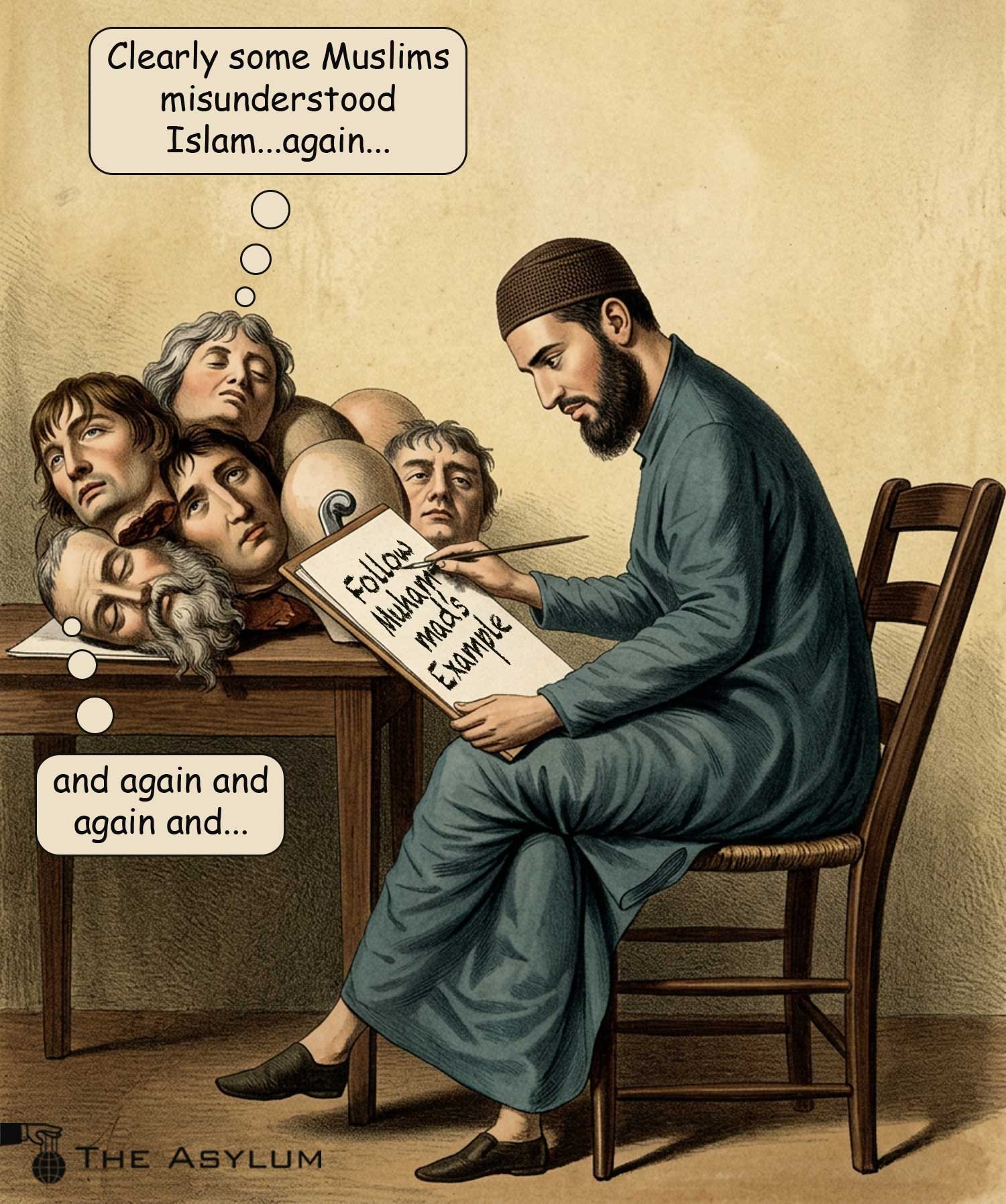
Around 15 years ago I went on little summer vacation to Mammoth, California, with two friends of mine. In the car ride up I voiced my opinion that the biggest threat to the U.S. and Western Civilization was Islam. I did not know how wrong I was. The biggest threat, it turns out, was and is our own governments, elected and unelected elites and the Mainstream Media.
It is the governments of Europe directed by the European Union that have allowed the unfiltered immigration of Muslims who are now plaguing countries like Great Britain, France, Germany, Sweden and others. Canada and Australia are in a similar situation. The Biden administration did the same thing here in America. Many, many of the illegal immigrants were Muslims who adhere to a belief system (it’s hardly a religion) that is not compatible with Western Civilization. Nor do many of these immigrant Muslims have any intention of assimilating into the cultures they have invaded. They’re here for conquest, not harmony.
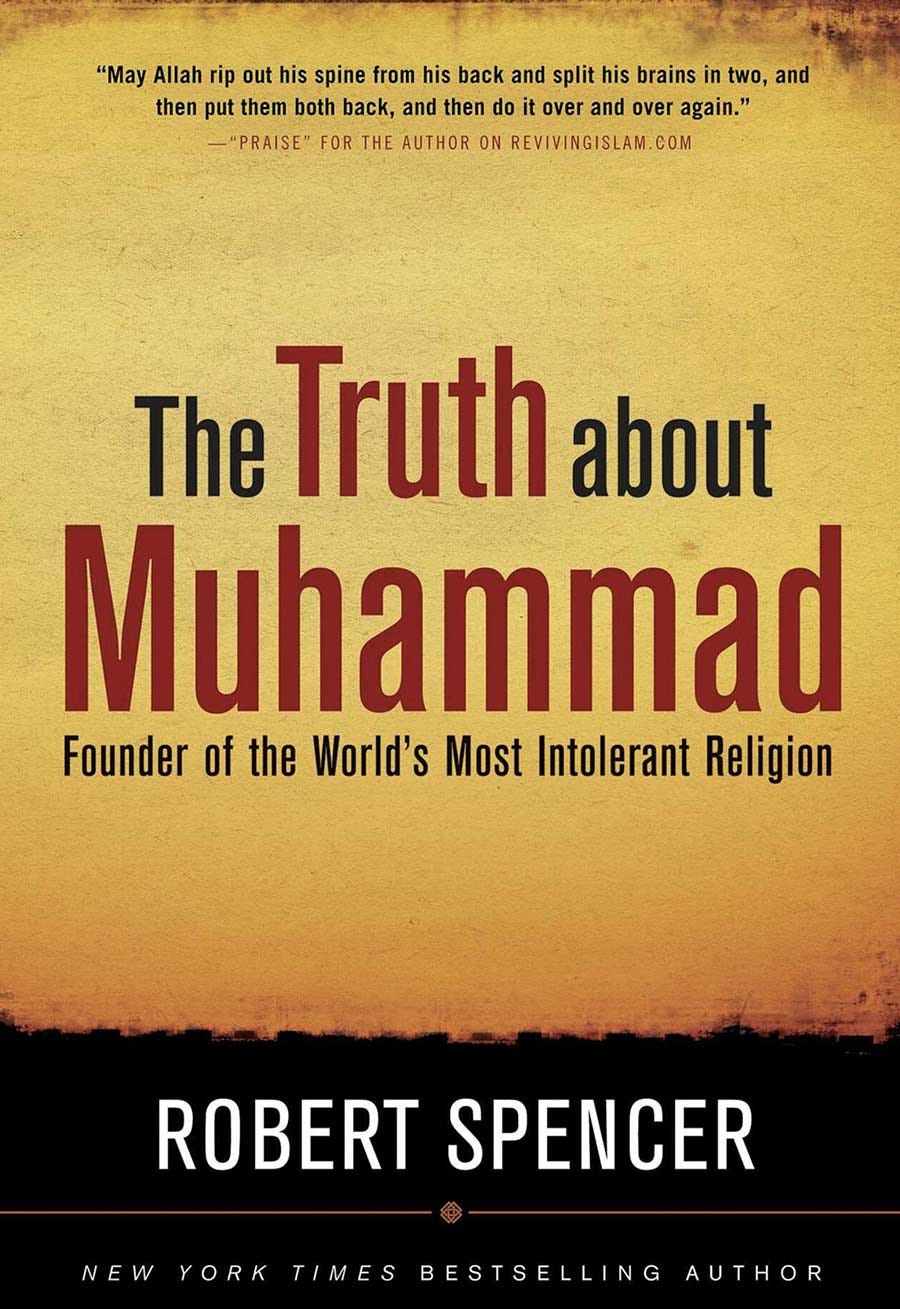
Robert Spencer’s book The Truth About Muhammad: Founder of the World’s Most Intolerant Religion was published in 2006. Spencer has published over thirty books on Islam and has been studying Islam since 1980. Of Spencer Ayaan Hirsi Ali wrote:
No one has upset the Islamophobia cabal more than Robert Spencer. First, he knows more about Islamic doctrine than they do. Next, he has outed all the tricks they use in their taqiyyah [concealment] bag to disinform the public. Finally, and most importantly, Robert will not be cowed.2
One of the main things I like about Spencer (like many other authors I’ve been reading) is that he uses accepted Islamic texts for his research. There can be no argument about what the texts say, only about interpretation.
Spencer writes that it can be difficult to prove the existence of Muhammad or that the events contained in Qur’an happened, but for this book it doesn’t matter.
For our purposes it is less important to know what really happened in Muhammad’s life than what Muslims have generally accepted as having happened, for the latter still forms the foundation of Muslim belief, practice, and law.3
This matters because for Muslims Muhammad is supremely important:
The Qur’an and Islamic tradition are clear that the Prophet is the supreme example of behavior for Muslims to follow. His importance to hundreds of millions of Muslims worldwide is rooted in the Qur’an, the Muslim holy book.4
Spencer quotes from the Qur’an and other Islamic sources including the Hadith which contains both commentary on the Qur’an and “traditions of the Prophet Muhammad”5 and the sunnah “or model, of the prophet.”6
If Muhammad is seen by Muslims as both a prophet and the Perfect Man (al-insan al-kamil)7, one they should emulate in every respect, it is important for Infidels (non-Muslims, Kafir, or unbelievers) to know how this man lived and understand why Muslims revere him and if he should be revered.
Spencer’s book covers Muhammad’s early life, his visitation from the angel Gabriel, how he wrote the Qur’an, his difficulties early on convincing people he was God’s prophet and his dealings with both Muslims and non-Muslims (Infidels). Muhammad started off milder and tolerant in Mecca, but later in Medina he becomes a warrior.
Muhammad was disappointed (to put it mildly) that the religious people around him, including both Christians and Jews, did not accept him as God’s prophet. It irritated him to such a degree that violence became his only option to convince them or at least force their conversions. Spencer writes:
As we shall see, Muhammad was often frustrated by skeptics of his preaching, with eventual dire results.8
Muhammad eventually offered non-Muslims three options:
convert to Islam,
subjugation which included a tax and behavior requirements or
warfare, i.e. death.9
If Islam is a “religion of peace,” if “there is no compulsion in religion,” why did Muhammad only offer these three options? Spencer’s point is that many Muslims don’t even know what the Qur’an says about Muhammad or how he truly lived. Others try to hide events of his life or even lie about them when pressed because they know it will not play well to people who would prefer to remain free.
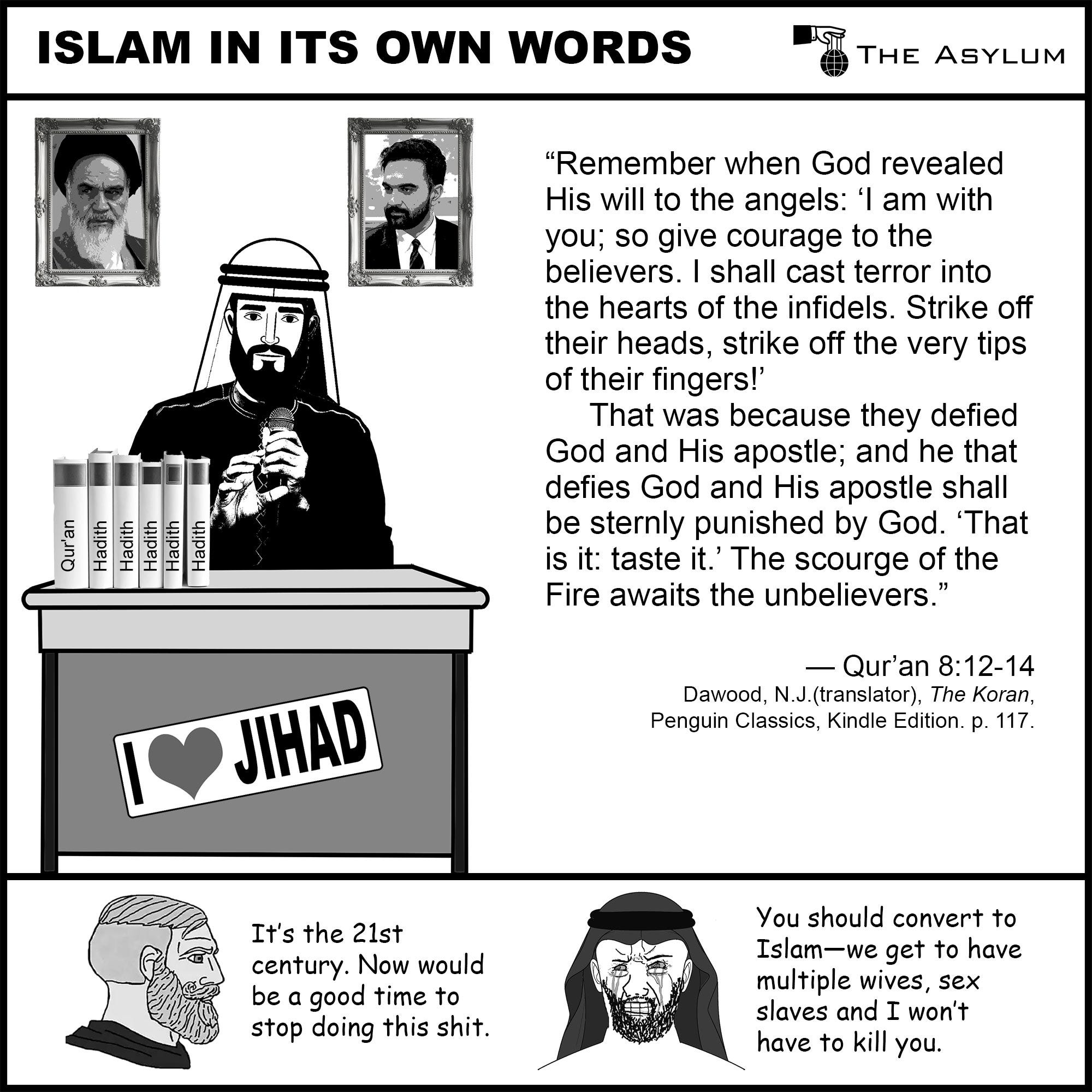
When Muhammad came up against something that was morally inconvenient, he would often get a revelation from Allah that provided an exception. For example, Muhammad desired the woman Zaynab, but she was married to his adopted son. The son found out about Muhammad’s admiration and separated himself from her even though Muhammad had told him not to. Such a union was forbidden to Muhammad. However, one day when talking to Aisha (the wife he married when she was six), he said: “Who will go to Zaynab to tell her the good news, saying that God has married her to me?”10
There is an account of Aisha saying to Muhammad: “Truly the Lord makes haste to do thy bidding.”11
This is a good book for an introduction to Muhammad’s life. Here are a few more quotes:
…the contrast between Muhammad’s teaching and that of Jesus (“let he who is without sin cast the first stone”) could not be more marked—and that difference has shaped Muslim and Christian history, culture, and ideas of mercy and justice.12
On this, A. C. Rosenthal has a couple of paragraphs that well explain how stark the difference is between Jesus and Muhammad; Christianity and Islam:
It is this: in Christianity, the founder is the standard against which the institution is measured. When the church falls short, the accusation is always: you are not living like Jesus. The standard itself is not in question. Jesus did not order raids. He did not arrange marriages with children. He did not authorize the execution of apostates. He was executed by the state, not empowered by it. Everything the church has done wrong can be measured against what Jesus actually did and found wanting. The standard holds.
In Islam, the founder is the standard. When you examine the primary sources and find things that trouble you, you are not finding a gap between Islam and Muhammad. You are finding Muhammad. The hadith I cited about apostasy is not a corruption of the tradition. It is from the most trusted collection in the tradition. The Banu Qurayza massacre is not a later invention. It is in the Sira, narrated with approval by the companion who participated. The marriage to Aisha [at 6 years old] is not a smear. It is defended by the tradition.13
Back to Spencer’s book:
Allah gave him a revelation allowing him to break treaties he had made with groups that he feared would betray him: “If thou fearest treachery from any group, throw back (their covenant) to them, (so as to be) on equal terms: for Allah loveth not the treacherous” (Qur’an 8:58).14
From a twenty-first-century perspective this is one of the most problematic aspects of Muhammad’s status as “an excellent model of conduct”: the treatment of women as war prizes, with no consideration of their will.15
I’ll be reviewing one of Spencer’s latest books, Holy Hell: Islams’s Abuse of Women and the Infidels Who Enable It, in the future.
While Jews, Christians, and other non-Muslims are allowed to practice their religions, they must do so under severely restrictive conditions that remind them of their second-class status at every turn.16
Muhammad participated in twenty-seven battles…17
It is nothing short of staggering that the myth of Islamic tolerance could have gained such currency in the teeth of Muhammad’s open contempt and hatred for Jews and Christians, incitements of violence against them, and calls that they be converted or subjugated.18
You can read a good summary of Muhammad’s life by Robert Spencer on his website here: “The Truth About Muhammad.” It has a lot of the same information that’s in the book in a much shorter format.
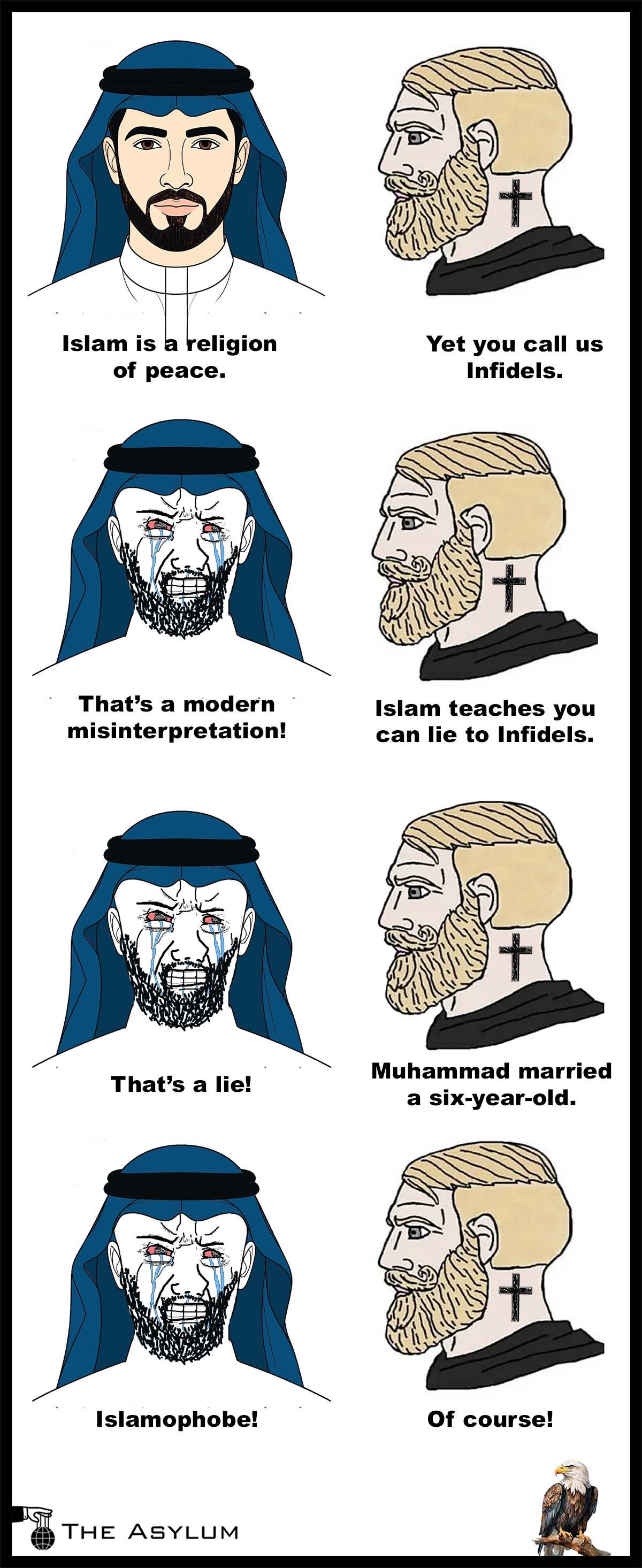
More from The Asylum’s Islam Series
Notes
Spencer, Robert, “Why Jihad Watch?”, Jihad Watch, Source
Ayaan Hirsi Ali, quoted on Jihad Watch, Source
Spencer, Robert. The Truth About Muhammad: Founder of the World’s Most Intolerant Religion (p. 50). (Function). Kindle Edition.
Ibid. p. 23.
Ibid. p. 41.
Ibid. p. 42.
Ibid. p. 50.
Ibid. p. 66.
Ibid. p. 102.
Ibid. p. 83.
Ibid. p. 94.
Ibid. p. 130.
Rosenthal, A. C., “I read the entire Quran, all the Hadiths, and the Sira. Here is what I found.,” A. C. Rosenthal, May 17, 2026, Source
Spencer, Robert. The Truth About Muhammad: Founder of the World’s Most Intolerant Religion, p. 141.
Ibid. p. 168.
Ibid. p. 190.
Ibid. p. 216.
Ibid. p. 224.
In one of his substacks, Rosenthal points out the two “versions” of the Qu’ran: the Meccan Period and the Medinan Period. The Meccan Period is a period of “constraint,” during which Muhammad had little power and had to present himself as unthreatening. These are the passages in the Qu’ran that are cited by Muslims that show Islam as a religion of peace. “The Medinan period, after the migration to Medina and the formation of a Muslim political and military state, produced the harder verses about warfare, subjugation, and the treatment of unbelievers.”
(https://acrosenthal.substack.com/p/i-read-the-entire-quran-all-the-hadiths)